
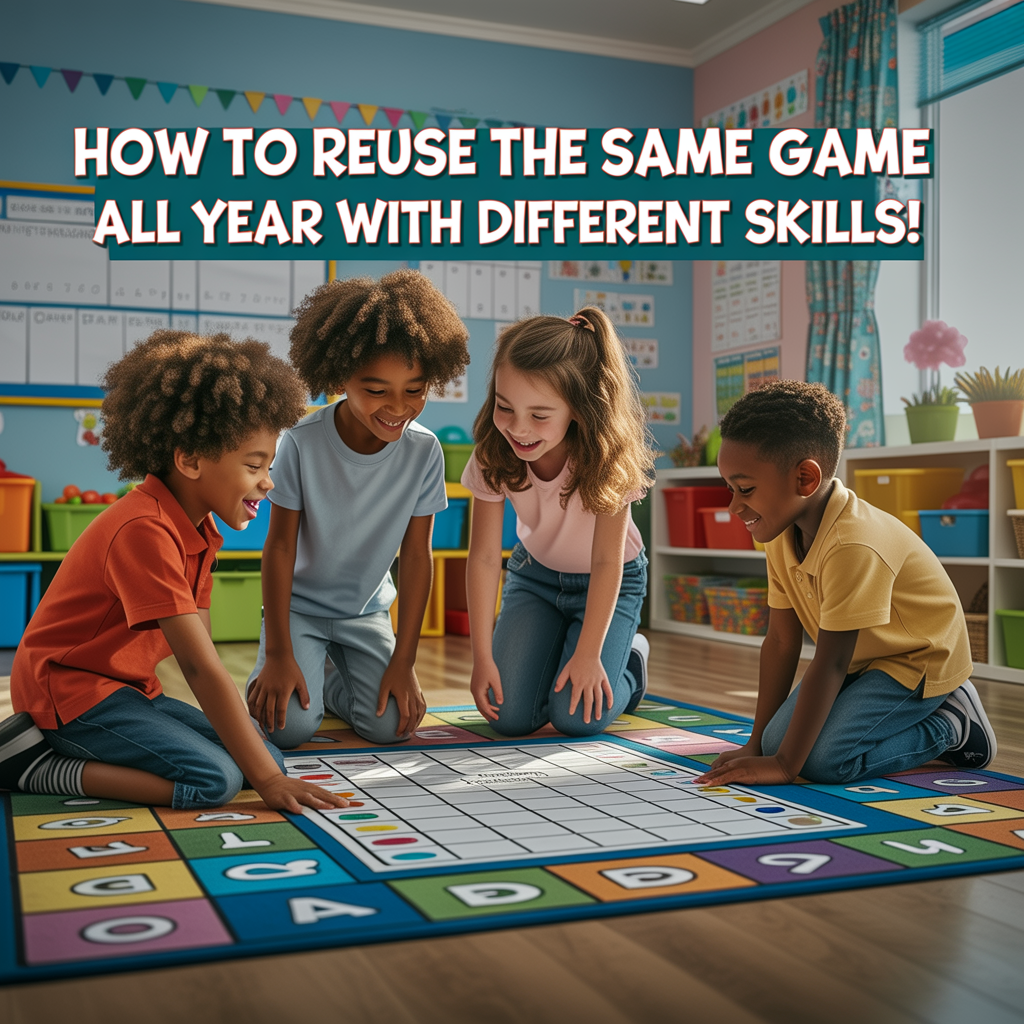
How to Reuse the Same Game All Year With Different Skills
A familiar classroom game can save your planning time without making practice feel stale. You keep the board, the routine, and the rules. Then you change the questions, vocabulary, or challenge to match what students are learning.
For elementary teachers, that means one game can work in September and still earn its spot in May. The format stays comfortable while the skill grows with your class.
Choose a Game Format You Can Use in Any Subject
The best reusable classroom games have simple rules and short rounds. Students should be able to start playing after one quick model, not spend ten minutes asking what happens next.
A board path, matching game, bingo board, scavenger hunt, task card challenge, or spin-and-answer game can all work. Pick one format that fits your room and your students. The learning target should change, not the whole game system.
Before you commit, ask:
Can students learn the rules in one round?
Does setup take less than five minutes?
Can students play with partners, small groups, or independently?
Is the noise level manageable for your classroom?
Can you check answers without stopping every turn?
Does the format fit your students' age and attention span?
A complicated game usually becomes a teacher job. A simple game lets students focus on the actual skill.
Build the Game Around One Simple Routine
Use the same routine every time: draw a card, solve the task, explain the answer, then move a piece or earn a point. That predictable pattern matters.
Students don't have to learn new directions during every unit. They can put their energy into multiplication, main idea, weather, or whatever you're teaching that week.
Model one full turn before play begins. Post visual directions where students can see them. In groups, assign roles such as reader, solver, checker, and recorder. Rotate jobs each round so one student doesn't do all the work.
Familiar rules free up brain space for new learning.
Prepare Materials That Can Change With the Skill
Keep the game parts separate from the content. A laminated board, dice, counters, dry-erase sleeves, folders, and editable task cards can last all year.
Store cards in labeled bags or envelopes by subject, unit, and difficulty level. For example, keep yellow cards for addition facts, blue cards for fractions, and green cards for word problems.
The same board can support math practice, vocabulary review, reading responses, science diagrams, and social studies facts. Only the cards need to change.
Reuse the Same Game by Changing the Learning Task
Think of the game as the container. The cards are what change with the curriculum.
Early in the year, a turn might ask students to count objects or name a letter sound. Later, that same turn can require an explanation, a drawing, or a written response. Students still know how to play, but the academic work gets stronger.
You can also use one format in different ways. During a lesson, use it for guided practice. At the end of a unit, use it for review. Before an assessment, add mixed-skill cards so students have to decide which strategy fits.
Use the Game for Math Skills and Problem Solving
In fall, students might draw cards that ask them to compare two numbers or solve an addition fact. As the year moves on, switch in cards for place value, subtraction, multiplication, fractions, measurement, geometry, and multi-step problems.
A student draws a card, solves the problem, explains the strategy, then moves spaces. That explanation is where you hear what they understand.
Don't let every answer be a quick shout-out. Ask students to show a number line, draw a model, use manipulatives, or write an equation. A correct answer with no thinking behind it tells you less than a student who can explain a mistake.
Adapt It for Reading, Writing, and Vocabulary
Reading cards can ask students to define a word, use it in a sentence, identify a text detail, make an inference, or summarize a paragraph. Use a shared text so students can point to evidence instead of guessing.
One card might ask, "What detail shows the character is worried?" Another might ask students to choose the best meaning of a word using context clues.
For writing, keep the prompts short. Ask students to replace a weak word, add a sensory detail, fix punctuation, or write a beginning, middle, and end for a quick story. The game creates small writing moments without requiring a full writing block.
Turn Science and Social Studies Review Into Active Practice
Science and social studies cards work well after direct instruction. Use them for life cycles, matter, weather, habitats, maps, communities, government, or historical figures.
Ask students to sort examples, label a diagram, compare two ideas, explain cause and effect, or apply a fact to a new situation. "What would happen if a plant got no sunlight?" gives you more information than "What does a plant need?"
Students should explain answers before moving. That keeps the game focused on understanding, not lucky guesses.
Keep the Game Fresh Without Making It Harder to Manage
Small changes can make a familiar game feel new. Change the cards, partners, response method, or goal. Keep the rules stable.
Use games as real practice, not only as a Friday reward. A 15-minute round after a mini-lesson can show you who is ready to move on and who needs another small-group lesson.
Adjust the Challenge for Different Learners
Color-code cards by level, but don't make the labels feel public. Students can work with different cards while playing the same game beside each other.
Offer word banks, sentence frames, number lines, or manipulatives when students need support. English learners may benefit from picture cards and partner talk before answering.
For students ready for more, add challenge cards. They might solve two problems, defend an answer, write their own question, or explain why another strategy would also work.
Use Quick Checks to Measure More Than Winning
Write down the skill students practiced, not only the winner. A simple checklist, answer sheet, exit ticket, or one-minute conference can give you useful information.
If several students make the same mistake, pause the game. Show a quick example, clear up the confusion, and let play continue. Accuracy, reasoning, teamwork, and improvement all matter more than reaching the finish line first.
Avoid the Problems That Make Games Feel Stale
Games fall flat when directions are unclear, turns take too long, or every card is too easy. Competition can also cause trouble when the same students always win.
Change the questions before you replace the game. Try cooperative goals, timed rounds, partner teams, or a whole-class challenge when students need less pressure.
At the start of each new unit, swap in fresh cards and remove old ones. That small habit keeps your materials organized and your game ready to use.
A Familiar Game Can Still Do New Work
A reusable game works because students know the routine while the learning target changes. Start with one simple format, prepare flexible materials, and trade out the cards as your curriculum moves forward.
The best classroom game creates meaningful practice, student talk, and quick teacher feedback. With thoughtful changes, one familiar game can carry a surprising amount of learning all year.