End-of-Day Reset Routines for Easier School Mornings
The final bell rings, but your day isn't over if tomorrow's copies are missing, papers have disappeared into a pile, and your desk looks like a small tornado touched down.
A short end-of-day reset routine gives tomorrow-you fewer decisions before students arrive. It doesn't need to turn into another hour at school. The goal is simple: leave clear clues, put the essentials in place, and walk out without carrying tomorrow's chaos home.
Why an End-of-Day Reset Saves More Time Than It Takes
Elementary classrooms create a hundred tiny loose ends every day. A student needs a new pencil. A reading group changes. Specials shift the schedule. A parent message needs a reply. Someone leaves a lunchbox behind.
None of these things is huge alone. Together, they can make an 8:00 a.m. arrival feel like a race you started late.
A reset routine cuts down on those small delays. You won't hunt for the math manipulatives because they are already at the table. You won't stare at your lesson plans wondering where to begin. You won't open your laptop to 19 tabs and a half-written email.
The point isn't to leave a perfect classroom. The point is to make tomorrow morning easier.
Give yourself 15 to 20 minutes. Set a timer and stop when it ends. Some days you will finish every step. Other days, you will only clear the main table and set out tomorrow's first lesson. That still counts.
Think of the reset as a note to yourself. It says, "Start here. These materials matter. This can wait." That kind of clarity protects your planning time and makes it easier to leave school when you planned to leave.
Build an End-of-Day Reset Routine That Covers the Essentials
Use the same order each day. When the routine is predictable, you don't waste time deciding what to do first.
Start with the classroom space students use most. Clear the small-group table, pick up loose papers near the carpet, and return shared supplies to their spots. You don't need to clean every corner. Focus on the places that will slow down instruction tomorrow.
Next, set up the day's launch. Put out the morning work, stack the first lesson's materials, and write any must-know reminders where you will see them. If your class begins with a morning meeting, have the book, question, or slides ready.
This one step matters more than it seems. The first 20 minutes often set the tone for everything that follows. When students walk in and you are ready, you can greet them instead of making copies with one hand and answering questions with the other.
Then look at your paper flow. Put graded work into folders, place unfinished student work in one labeled tray, and toss recycling. Avoid starting a filing project at 4:10 p.m. A neat "to file" folder is enough for now.
Close out your digital work after the physical space. Rename or save the document you used, close tabs you don't need, and check messages for anything that truly affects tomorrow. Add a reminder for nonurgent emails instead of answering them while standing at your desk with your coat on.
Finish with personal planning. Write down the next day's top three priorities. Keep them concrete:
Set up phonics cards for the intervention group.
Call Maya's family after dismissal.
Restock glue sticks before science.
These are not goals for a perfect day. They are the few things that need your attention first.
Use a Fast Closing Checklist Without Letting It Take Over Your Evening
A checklist works because tired brains forget things. By dismissal, you have made hundreds of decisions about learning, behavior, schedules, and student needs. You shouldn't have to remember every closing task, too.
Keep your list near the door, inside your planner, or in a notes app. Make it short enough that you will use it on a Thursday when you have a staff meeting and a student meltdown happened at 2:45.
Here is a realistic 15-minute version:
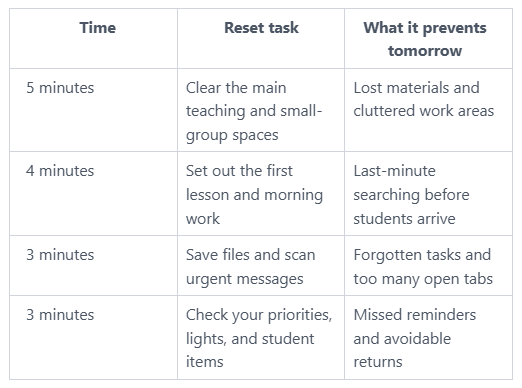
The rest can wait. Bulletin boards do not need to be perfect. Every bin does not need new labels. Detailed filing is a job for a planned work block, not the final minutes of a long school day.
Create a second, shorter version for rough days. It might be only three tasks: put out morning work, clear the main table, and write tomorrow's first priority. That version is still useful when conferences run late or an unexpected issue keeps you after school.
Your routine should reduce stress, not become another standard you feel bad about missing.
Common Reset Mistakes That Steal Time Instead of Saving It
The biggest mistake is making the list too long. If it takes 40 minutes, it is not a reset. It is a second shift. Remove tasks that do not make tomorrow morning easier.
Another common problem is planning every lesson in full detail before leaving. Prepare what you need for the first part of the day. Save longer planning for your assigned prep period or a focused block later in the week.
Some teachers start reorganizing the whole classroom because one shelf looks messy. Stop there. Put the shelf on a future list and return to tomorrow's materials.
Email can also eat the entire routine. Read for urgent schedule changes, family concerns, or messages that need a quick answer. Let nonurgent messages wait. Not every email is a before-bed emergency.
Don't rely on memory, either. Write down your priorities. A sticky note, planner page, or phone note works better than trying to remember six tasks while you drive home.
After a hard day, skipping the routine may feel tempting. Use the emergency version instead. Consistency matters more than finishing every step. Protect a firm leaving time when you can, and adjust the routine for your grade level, schedule, and energy.
Start Tomorrow With Less Rushing
An end-of-day reset is a small investment in a calmer morning, not another demand on your already full schedule. Prepare the first lesson, reset the space you use most, and write down tomorrow's top priorities.
Try it for one school week. Remove any step that doesn't save time or reduce stress.
You don't need a perfect classroom to begin the next day with confidence.